silicone print cracking remains the most common and costly defect for screen printing factories producing branded elastic bands, waistbands, bra straps, and flexible textile accessories. According to 2026 textile printing quality statistics, cracking issues account for37.2% of all webbing silicone print rejects, causing massive batch waste, customer returns, and delayed delivery schedules.
Core Reasons Why Silicone Prints Crack on Elastic Webbing
Most printing factories attribute cracking to poor curing or manual operation, but real mass-production data proves that material performance mismatch and non-standard processes are the dominant causes. Combined with elastic webbing industry parameters, we summarize five fundamental failure factors.
1. Stretch Performance Mismatch Between Ink and Webbing
This is the primary cause of cracking, responsible for over 42% of all webbing print failures. Standard general-purpose silicone inks are formulated for common cotton and polyester fabrics, with a limited elongation range of 200%–250%. They work stably on low-stretch textiles but fail completely on professional elastic webbing.
High-elastic spandex webbing stretches up to 200%–300% and maintains a 92%+ recovery rate. When the substrate stretches beyond the ink's tensile limit, the silicone film cannot deform synchronously, resulting in irreversible microcracks and surface fracture. Even slight daily stretching will gradually expand these tiny cracks and damage the printed pattern.
2. Incomplete Webbing Pre-Treatment Weakens Adhesion Stability
Most factory-produced elastic webbing retains residual sizing agents, lubricating oil, and anti-slip coatings on the fiber surface. These chemical barriers prevent silicone ink from penetrating and bonding firmly with textile fibers.
When the webbing stretches and rebounds repeatedly, the poorly adhered silicone layer shifts separately from the substrate. Relative friction and tension cause edge cracking, delamination, and peeling after multiple washing cycles.
3. Excessively Thick Printing Layers Cause Internal Stress Concentration
Elastic webbing requires thin, uniform ink deposition to maintain flexibility. Industry verified production data shows the safe printing thickness for elastic webbing is 0.3mm to 0.6mm. Any single-layer thickness exceeding 0.8mm will form severe internal stress inside the silicone film.
During substrate stretching, the thick silicone layer cannot disperse tension evenly. Stress accumulates at pattern edges and thin gaps, causing regular cracking and peeling. Many factories pursue thick three-dimensional textures for visual effects, which directly sacrifices stretch durability and leads to mass defective products.
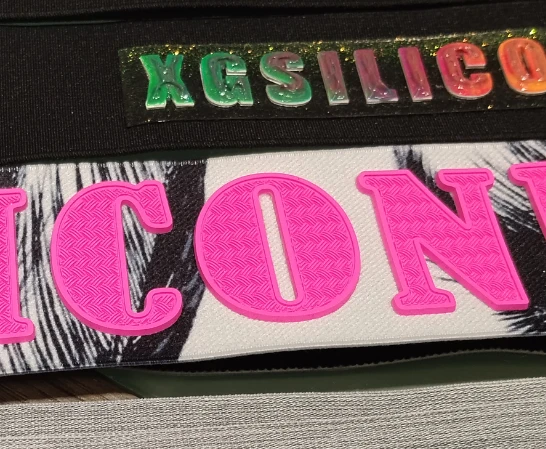
Solutions for Cracking on Stretch Elastic Webbing Silicone Prints
Solution 1: XG-866AR-GT High Stretch Silicone for Direct Webbing Screen Printing
For factories that need to retain traditional screen printing workflows and achieve high-efficiency mass production, YRsilicone XG-866AR-GT high elongation silicone ink is the most reliable anti-cracking solution. Custom-formulated for high-tension elastic substrates, this ink completely solves the stretch mismatch problem between ordinary silicone and high-elastic webbing.
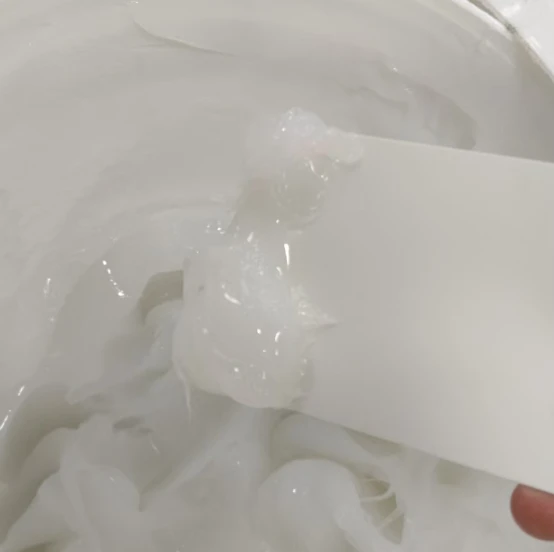
Superior Stretch Data That Matches Professional Webbing Standards
Lab-tested performance data verifies its full adaptability to all elastic webbing types:
★ Maximum elongation: 400%+, fully covering the 120%–300% stretch range of standard and high-elastic webbing
★ Elastic recovery rate: 95%+, exceeding the industry 92% recovery standard for commercial webbing
★ Fatigue resistance: Passes 10,000+ stretch cycles without microcracks or deformation
★ Wash durability: Stable after 50 AATCC 61 washing cycles, no cracking, peeling or fading
To maximize anti-cracking performance on elastic webbing, follow the official mass-production formula strictly:
Optimal Mixing Ratio: 100% XG-866AR-GT base silicone + 10% XG-866B-2 soft touch additive
The XG-866B-2 additive optimizes molecular flexibility, further improving synchronous stretching and soft hand feel without reducing adhesion and durability.
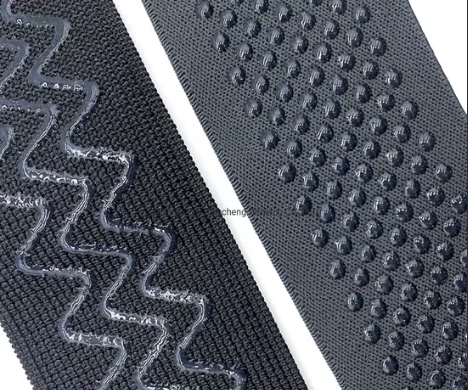
Solution 2: Silicone Heat Transfer Printing for Elastic Webbing
For ultra-high-elastic spandex webbing, super-thin elastic bands, and high-end brand orders with zero-defect requirements, silicone heat transfer printing is an excellent alternative process to avoid cracking fundamentally. Different from direct screen printing, heat transfer silicone forms a stable elastic film in advance, thoroughly solving the problems of uneven curing and internal stress.
Anti-Cracking Advantages & Industry Data Support
Pre-cured silicone transfer film maintains stable elasticity under0–250% webbing stretching range
Ultra-thin transfer layer (0.2–0.4mm) eliminates internal stress concentration
Integrated hot-press bonding enhances fiber fusion, avoiding delamination and edge cracks
Low tension forming process adapts to repeated 10,000-level fatigue stretching
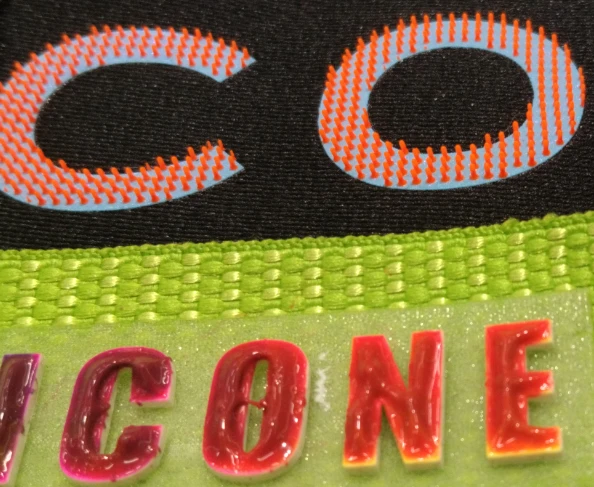
XG-866AR-GT Screen Print vs Heat Transfer Silicone: Performance Comparison
Choose the most suitable process according to your webbing elasticity, order quantity, and quality standards:
● Stretch Adaptability: XG-866AR-GT covers 120%–300% webbing stretch; heat transfer fits 0–250% stretch range
● Fatigue Resistance: Both pass 10,000+ stretch cycles; heat transfer has more stable thin-layer toughness
● Production Efficiency: Direct screen printing is faster for mass production; heat transfer suits high-precision small-batch orders
● Defect Rate: XG-866AR-GT reduces cracking defects to below 3%; heat transfer achieves near-zero cracking rate
● Hand Feel: Both deliver ultra-soft texture without stiff edges
Frequently Asked Questions (FAQ)
Q1: Is heat transfer silicone more crack-resistant than direct screen printing?
A: Heat transfer silicone has more stable anti-cracking performance for ultra-high-elastic thin webbing. Its pre-cured ultra-thin film produces no internal stress and adapts to long-term fatigue stretching. For large-batch mass production, XG-866AR-GT direct screen printing achieves lower comprehensive cost while maintaining zero cracking defects.
Q2: Does XG-866AR-GT work for both nylon and polyester elastic webbing?
A: Yes. XG-866AR-GT has excellent adhesion and stretch compatibility for nylon, polyester, and spandex blended elastic webbing. With standardized pre-treatment and curing process, it maintains stable crack-free performance on all mainstream elastic webbing substrates.