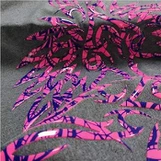
Screen printing, also known as silkscreen printing or serigraphy, is a popular printing technique that utilizes a stencil and a mesh screen to transfer ink onto various surfaces like fabric, paper, metal, or plastic. Utilizing this technique, one can print designs on T-shirts, web product,underwear,posters, signage, labels, and many more products.
Heat transfer printing with silicone ink for logo:

Screen printing has been around for centuries. Earlier, it was used by the Chinese to print silk for clothing and decorative purposes. In the 20th century, it received a significant boost in popularity as an art form after artists such as Andy Warhol and Robert Rauschenberg popularized it as a technique for creating fine art.
The process of screen printing involves three key elements - the stencil, the mesh screen and the ink. The stencil is a design or image that is cut out of a thin and flexible material such as paper, plastic or metal. It is placed on top of the mesh screen, which is like a fine sieve, made of nylon, polyester, or silk threads, with microscopic holes in it. The stencil blocks out the areas where ink is not required, creating space for ink to pass through the open spaces on the screen. The ink is then placed on top of the screen, which is then spread across the stencil using a squeegee. The ink then passes through the open areas on the screen and onto the surface below, creating the final printed image.

The ink is heat cure.Hence,you must bake every screen printing ink layer with oven.
Baking temperature :100-120℃
Baking time:10seconds
You only bake the silicone for surface before starting printing next layer.Because the silicone logo printing need print many times for high thickness with 3D design.

In more technical terms, the process of screen printing can be broken down into several steps:
1. Design Creation - The first step in screen printing is the creation of the design. The design can be created using either a computer or by hand. Once the design is finalized, it is printed out onto a transparent or opaque film.
2. Stencil Creation - The next step in screen printing is creating the stencil. The stencil, as mentioned earlier, can be created using a range of materials such as paper, plastic, or metal. The stencil is cut out using either a craft knife or a laser cutter.
3. Screen Preparation - The screen mesh is then stretched onto a frame and secured tightly in place. A thin layer of emulsion is then applied to the screen. The emulsion is light-sensitive and will harden when it's exposed to light.
4. Image Exposure - The image is then placed face-down onto the emulsion and exposed to a strong light source. The light hardens the emulsion where it's not covered by the design, while the area that's blocked remains soft.
5. Washout - Once the screen has been exposed, it's then washed with water. This washes away all of the areas of the emulsion that didn't harden because they were blocked by the design.
6. Ink Application - The ink is then applied to the screen using a squeegee. The ink must spread evenly across the mesh screen, passing through the areas of the screen that were exposed during the washout process.Before screen printing ink,please mix ink base with catalyst,color pigment,thinner thoroughly.
7. Printing - The final step is printing. The screen is lowered onto the printing surface, and the ink is transferred to the material by applying pressure using a squeegee.Silicone ink printing need belved squeegee,angle between 65-75°.The squeegee must be soft rubber.


Screen printing is a versatile and effective printing technique that can create vibrant and long-lasting prints on a range of substrates. One of the biggest advantages of screen printing is its ability to produce large quantities of prints at an affordable cost. Additionally, the process is relatively simple to set up and can produce high-quality results with some practice.
Screen printing is used widely across different industries, including fashion, marketing, merchandising, and art. It is a versatile technique that can be used to produce everything from promotional materials to complex and intricate designs on clothing and other textiles.
If you add temperature change powder in the silicone product,you print color change design.


You can use different mesh screen to print 3D design:

YR silicone can supply glossy and matte silicone.
After screen printing glossy ink,please wait for five minutes.Then bake the printed design till the ink is cured thoroughly.
In conclusion, screen printing is a popular and versatile printing technique that involves a stencil, a mesh screen, and ink to transfer an image onto a broad range of surfaces. The process is relatively simple and cost-effective, making it a popular choice in various industries. With advancements in technology and equipment, screen printing is expected to continue being a popular printing technique well into the future.
Hot Tags: silicone logo printing, suppliers, factory, custom, wholesale, buy, bulk, low price, in stock, free sample, made in China, screen printing places, Eco friendly Silicone Screen Printing Ink Made in China, Screen Printing Machine in stock, heat press printing machine, clear screen printing ink, ink tee shirt printing